Most owners can name the problem. Fewer can name the constraint.
A 15-minute assessment that reads your answers against each other and tells you what is actually limiting the business — not what you would have guessed.
Your free report will arrive by emailThis is a diagnostic instrument, not a lead magnet
The report tells you what it found and stops there.
You answer questions about how the business actually runs — your numbers, your customers, your last major decision, what would stop working if you disappeared for two weeks. The methodology reads those answers against each other and produces a structural finding: where the business is constrained, and what the evidence says is causing it.
There is no call to schedule, no sequence to escape, and nothing to install. What you do with the finding is yours to determine.
Three things it does that most assessments do not
-
01
It looks for the gap between the problem you name and the problem your answers describe.
Owners usually arrive with a diagnosis already in hand — we need more leads, we can't find good people, the market is tough. Often that reading is accurate at its level and incomplete underneath. The instrument is built to find the layer beneath.
-
02
It reads behavior, not intention.
"Do you market consistently" invites a flattering answer. "How many months in the last twelve did you contact prospects" reveals what happened. The questions are written the second way, and some of them will feel unexpectedly direct.
-
03
It says plainly what it cannot determine.
Every report carries a section naming what the assessment could not reach, and why. An instrument that answers every question is not being careful — it is guessing and not telling you.
Your personal report runs roughly six pages, and it is about your business specifically
Your own answers are quoted back where they are the evidence. It arrives by email a couple of minutes after you finish.
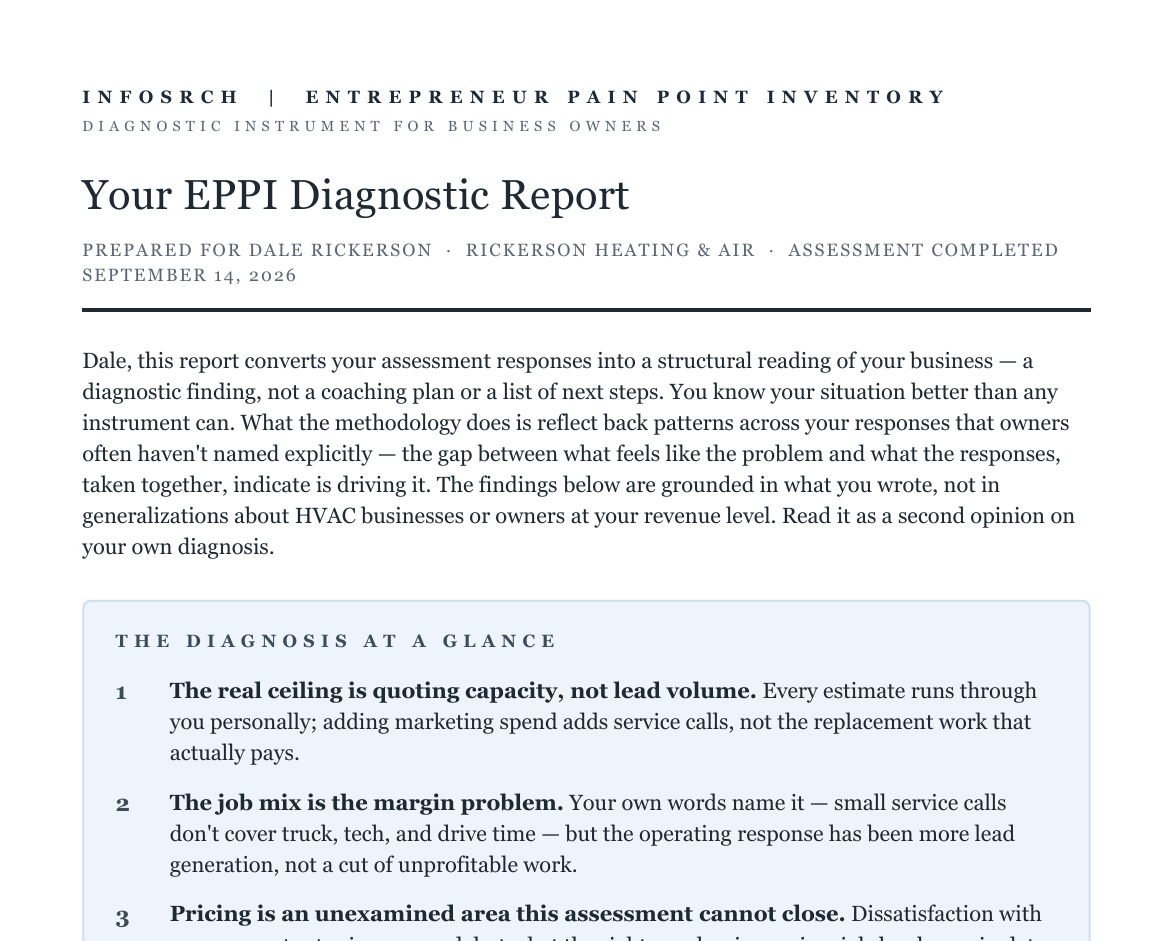
- The pattern — the gap between the problem as it presents and the structure underneath it
- A primary finding, with the mechanism named and the evidence cited
- A second signal — the pattern running alongside the first
- Hidden dynamics your answers pointed at without stating
- Honest limits — what the assessment could not reach
- What to watch for — signals that the pattern is shifting or hardening
Dr. Peter Francis

Ph.D. in Organization and Management, and nearly thirty years diagnosing performance gaps at institutional scale — most recently as an Academic Director responsible for academic strategy across 180,000 active students.
The instrument is built on the same discipline: read the evidence, name the mechanism, and say plainly where the evidence runs out. His personal mission is to distill the wisdom of the ages — cut through the noise, find the truth, package it into actionable forms, and share it widely.
You are not the only one running into this
Most owners have no idea whether what they are dealing with is theirs or structural.
Your report reads one business. The Business Pain Point Index reads all of them together — the patterns that recur across respondents, the misdiagnoses that show up again and again, and the shapes a constraint takes in a three-person shop versus a thirty-person one.
Findings and patterns, not just percentages. What owner dependency actually looks like across many businesses. Which problems owners consistently name, and which ones the evidence consistently points at instead. Where the same constraint shows up under different descriptions.
Deidentified and aggregated throughout. Individual responses and reports are never published, and any direct quotation is used only with the respondent's specific permission for that passage.
It is early. The Index is built from the respondents who take part, which means the first participants shape what it can see. As a participant in the study you will receive a free copy of the Business Pain Point Index when it is released.
Owners of real operating businesses
Trades, construction, service firms, dealers, manufacturers, professional practices. People with real revenue, real payroll, and real exposure.
It works best if you have been at it long enough to have patterns worth reading. It works least well pre-revenue, because there is not yet enough behavior to diagnose.
EPPI reads your own business. If you are a coach or consultant looking for an instrument to run on your clients, that is a separate product and it is in development.
Three things that make the report worth reading
Answer as things actually are, not as you would like them to be. The instrument is looking for pain points, and a rosy answer produces a report that is no use to the person reading it — which is you.
Answer from memory. Don't research anything. If you do not know a number, say so; there is an option for that and it is a real answer.
Take it in one sitting. The questions build on each other, and the analysis reads them together.